The pattern is so common it has a script. Week one, the owner picks a posting day and sticks to it. Week two, a real-work fire eats the morning and one post slips to Thursday. Week three, the slip becomes a guilty single post on Friday night. Week four, nothing. By week five the calendar quietly disappears from the to-do app and "be more consistent on social" joins the list of things that didn't take.
A founder on r/smallbusiness compressed the whole arc into two lines:
"Week 1: I'm on it. Week 2: real work hits. Week 3: guilt post. Week 4: back to nothing."
The interesting part is how reproducible it is. Different industries, different team sizes, different platforms — the curve is the same. That's not a willpower failure. Willpower failures don't repeat that cleanly across thousands of owners. What you're looking at is a system failure, and the system that breaks looks roughly the same in every case. The fix is also the same, and it does not start with "post more."
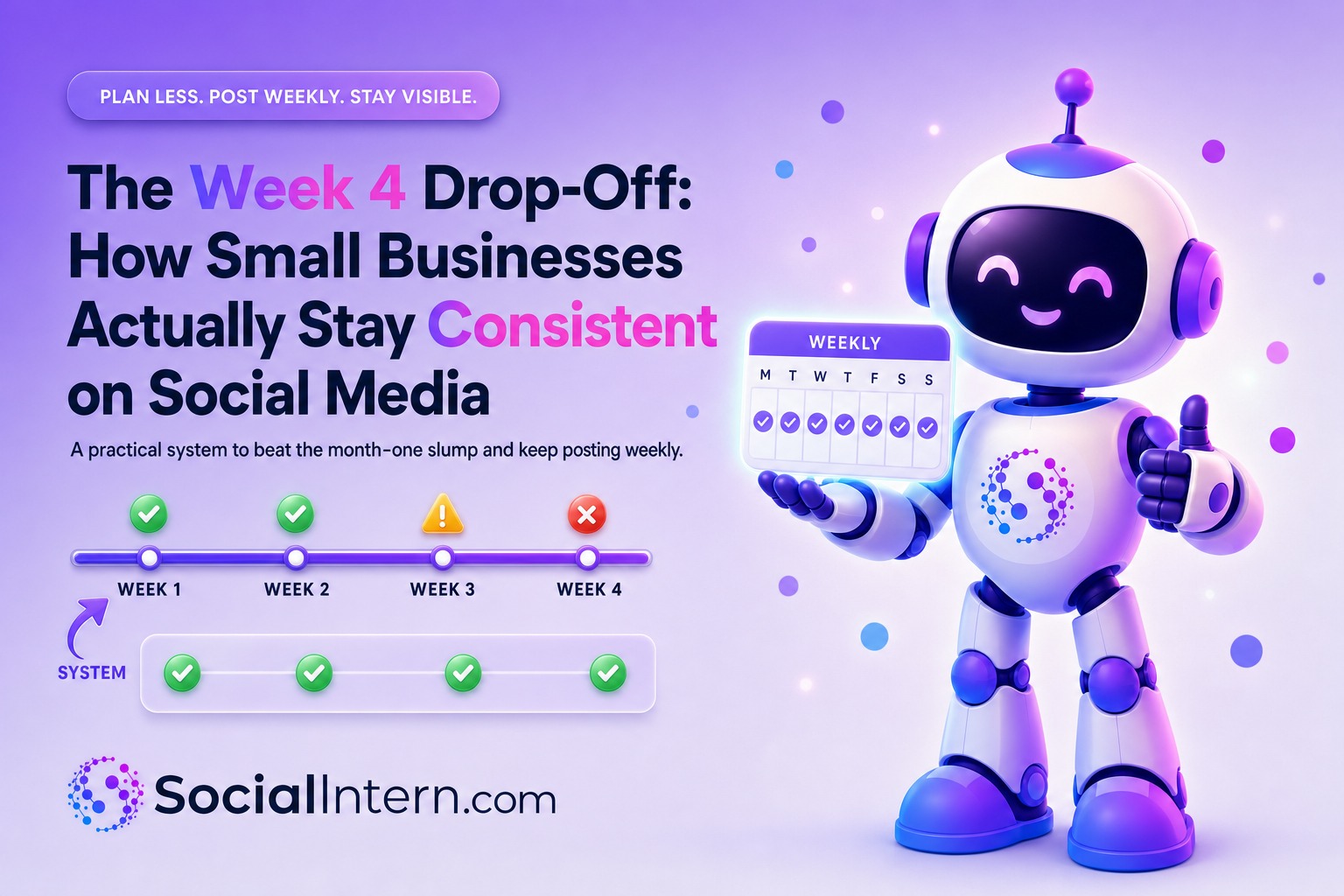
The drop-off is a system failure, not a willpower failure
When something breaks identically for almost everyone who attempts it, the problem isn't the people. The problem is the design. "Post three times a week" is a goal, not a system. It sits on a fragile chain of upstream decisions: think of a topic, write a caption, pick or make an image, format for the right platform, log in, schedule it. Each step is a small ask. The chain is long, and the chain breaks at whichever step gets the busiest week.
The most candid description we've heard came from a cleaning-service owner: "Marketing is inconsistent, maybe two posts a month. I try batching content on Sundays but it rarely happens." The Sunday batch never happens because Sundays are also when invoicing happens, and quotes get sent, and the family wants a few hours. The system assumes one quiet block per week — and small businesses don't reliably have one.
Reframing the failure as a system problem is the unlock. You're not lazy and you're not behind. You're trying to run a workflow that has too many decisions for the worst week of the quarter.
Why batching alone breaks
Batching is the conventional fix. Block off 90 minutes on Sunday, write a week of posts at once, schedule them, walk away. It works for one or two weeks, and then it goes the way of every other plan: a real-work week eats the Sunday block, the queue runs dry on Tuesday, and the cycle restarts.
Batching breaks for the same reason daily posting breaks — it concentrates the entire month's social-media labor into a recurring chunk of time that competes with whatever else needs that chunk. The chunk is shorter, but it's still vulnerable to a single bad week. As one owner put it on the same thread: "It honestly feels like you need constant effort just to stay visible."
The flaw isn't the idea of batching. It's that the batch is treated as a creation task — sit down and write five posts — when the bottleneck for most owners is not writing. It's deciding what to write, every time, while juggling everything else. Move the decision-making out of the batch and the batch becomes a 10-minute review instead of a 90-minute sprint, which is a workload an actual small business can absorb.
Cut the workflow down to one decision
The reason small business owners can stay consistent with payroll, invoicing, and email but not with social posts is that those other workflows have one decision in them. Run payroll: yes or no? Send the invoice: yes or no? Reply to this email: yes or no? Each of those is a one-second cognitive step, and you can do them in a parking lot.
Social posting in its default form has the opposite shape. A single post might require: pick a topic from nothing, decide what to say about it, write the caption, edit the caption, find or create an image, decide if the image fits, write platform-specific variants, and then schedule everything. That's six or seven decisions, and the owner has to make all of them before anything ships.
The fix is to compress the chain to one decision per post: publish this, or skip it. Everything upstream — topic, caption, image, format — is decided ahead of time, by something other than the owner's Sunday-night brain. The owner's job is to approve or veto, not to create. That's a workflow that survives a busy week because it doesn't require uninterrupted time. It requires ten seconds at a stoplight.
This is the same principle that makes content pillars work at the planning level — pre-deciding the categories so that the in-the-moment decision becomes "which pillar today" rather than "what is my entire content strategy." Pushing the same logic further down the workflow is what closes the consistency gap.
Set the cadence below your worst week
One of the most common reasons consistency collapses is that the chosen cadence was calibrated to a good week. Five posts a week is achievable in February. It's impossible the week your biggest client renegotiates the contract and your delivery van breaks down.
A useful rule: pick a cadence you could maintain during your worst typical week, then add one. For a service business, that's often three posts a week, sometimes two. For a heavily seasonal business — landscapers in February, accountants in April — it can drop to one. The goal isn't to look prolific. It's to never have a four-week gap. A profile with one post a week, every week, looks alive. A profile with five posts in one week and silence for three looks dead.
The owners who eventually figure this out describe it in some version of the same line: "Something consistent that survives real business chaos. Doesn't depend on motivation." Cadence below your worst week is the operational version of that sentence.
What "good enough" actually looks like
The other reason consistency collapses is overshooting on quality. A polished, on-brand, perfectly designed post takes 45 minutes when you're doing it from scratch. A "good enough" post takes five. The five-minute post is the one that ships every week. The 45-minute post is the one that gets postponed.
For most service businesses, a "good enough" post is a phone photo with one or two sentences of caption that demonstrate the business is doing real work. A before-and-after, a behind-the-scenes shot, a thank-you to a recent customer, a heads-up about availability. None of these require a design tool or a content calendar. They're the visual equivalent of leaving the lights on at the front of a restaurant — proof the business is open.
This bar applies even when the underlying generation is automated. AI-drafted captions, AI-generated images, scheduled posts — the entire point is to keep the bar low enough that the system survives the week the office floods. The moment your "good enough" creeps back toward "publishable in a magazine," the workflow starts to break again.
The minimum system that survives real life
Put the pieces together and the actual minimum system is short. One: pre-decide the topics so the in-the-moment decision is smaller. Two: have something draft the posts on a fixed cadence, not on motivation. Three: turn approval into a single yes/no/skip step that fits into the gaps in a real day. Four: set the cadence at a level you'd hit during your worst typical week, not your best.
That's the shape of Social Intern. It generates your week of posts on a day and time you set, drafted in your brand voice and tagged to your content pillars, and pings you to approve them in Slack or email. Approving is three buttons: approve, skip, delete. If your pipeline is empty, it nudges you. The decision count per post drops from six or seven to one — and the cadence keeps running whether you remembered to think about social this week or not.
None of that is magic. It's just removing the steps where the chain usually breaks. The owners we hear from who finally get past the week 4 drop-off describe the same shift: they stopped trying to be the source of the content, and became the editor of it. Automation only helps when it removes the right decisions — the ones that were stealing your evenings. Automating the wrong steps (like adding "review and customize my AI workflow" to your to-do list) just adds a new layer to the chain that breaks.
If the week 4 drop-off is the pattern you keep hitting, the fix isn't trying harder — it's a workflow with fewer steps. Book a demo and have a week of posts queued up, ready to approve, by the time you finish your coffee.
When the gap is bigger than a system can close
Honest closing thought: not every business should be posting more. If you've done the math and social isn't a meaningful credibility or discovery channel for your audience, the right answer might be to post less and put the time into Google reviews, referrals, or the actual product. A founder on r/Entrepreneur put it bluntly: "Most people try something for three weeks and switch. The ones who grow are the ones who show up regularly and treat it like a long game." That logic applies to social, but it applies to every other channel too — and pretending social is your long game when something else is the real channel is its own kind of consistency failure.
For most small businesses, though — particularly local service businesses where customers do a quick profile check before calling — keeping the profile alive is one of the lower-effort, higher-leverage things you can do. The point isn't to win social. It's to make sure you don't lose calls because someone scrolled, saw no recent posts, and moved on to the next business on the list. Build the smallest system that survives a real week, set the cadence below your worst one, and let consistency compound from there.
Frequently Asked Questions
For most small service businesses, once a week — every week — is a reasonable floor. The number that matters isn't posts per week; it's "weeks without a post." Two or more weeks of silence is when a profile starts to read as inactive to a potential customer doing a quick check.
No. Doubling up is what kicks off the next round of the drop-off cycle — the catch-up week feels overwhelming, then the following week feels permissible to skip. Just restart the cadence cleanly the next scheduled day. A profile with a missed week and then a fresh post reads as a healthy business, not a guilty one.
You can, but it's higher-risk. A monthly batch concentrates the entire workload into one session — miss that session and the gap is four weeks, not one. Weekly batches keep the worst-case downside smaller. If a tool generates the batch for you, the difference matters less, because you're not the one creating each post.
Usually not. The same post can publish to Instagram, Facebook, X, and LinkedIn from one approval if your tool supports it. The thing to optimize is whether the caption and format suit each platform — not whether you're posting a different number of times on each one. A consistent weekly post across all your connected platforms is plenty for most small businesses.
A message arrives in Slack or your inbox with the draft caption and the proposed image, plus three buttons: approve, skip, delete. Approve sends the post into the queue. Skip moves on. Delete removes the draft. The whole decision is binary and takes seconds — which is the point. Anything that requires you to open a separate app and "review your content" defeats the purpose.
Authenticity is mostly a function of two things: the brand voice the tool was trained on and your willingness to edit before approving. Generic AI captions read robotic because the underlying voice is generic. A tool that learns your actual voice from your website and existing social, and gives you a chance to tweak before publishing, can produce posts that sound like you wrote them on a quiet morning.