A boutique owner on r/smallbusiness posted this last month, almost apologetically: "I've tried more complete setups before and just burned out on them." She wasn't talking about social media itself. She was talking about the tools — the scheduler, the analytics dashboard, the canvas editor, the hashtag generator, the inbox unifier. Each one had a free trial. Each one promised to be the last one she'd ever need. None of them got her posts out the door more reliably than her phone did.
This is the quiet trap most small businesses fall into with social media. The tools sold as time-savers, stacked together, become the thing that eats the time. Every login is a context switch. Every duplicate dashboard is a question of which number to trust. Every monthly subscription is a low-grade decision tax that follows you into the rest of your week. By the time the stack is "complete," posting has somehow gotten harder, not easier.
This post is about how that stack accretes without anyone deciding to grow it, what it actually costs, and a weekend audit that most owners can use to cut their social media tool list roughly in half — and get more posts out the door as a result.
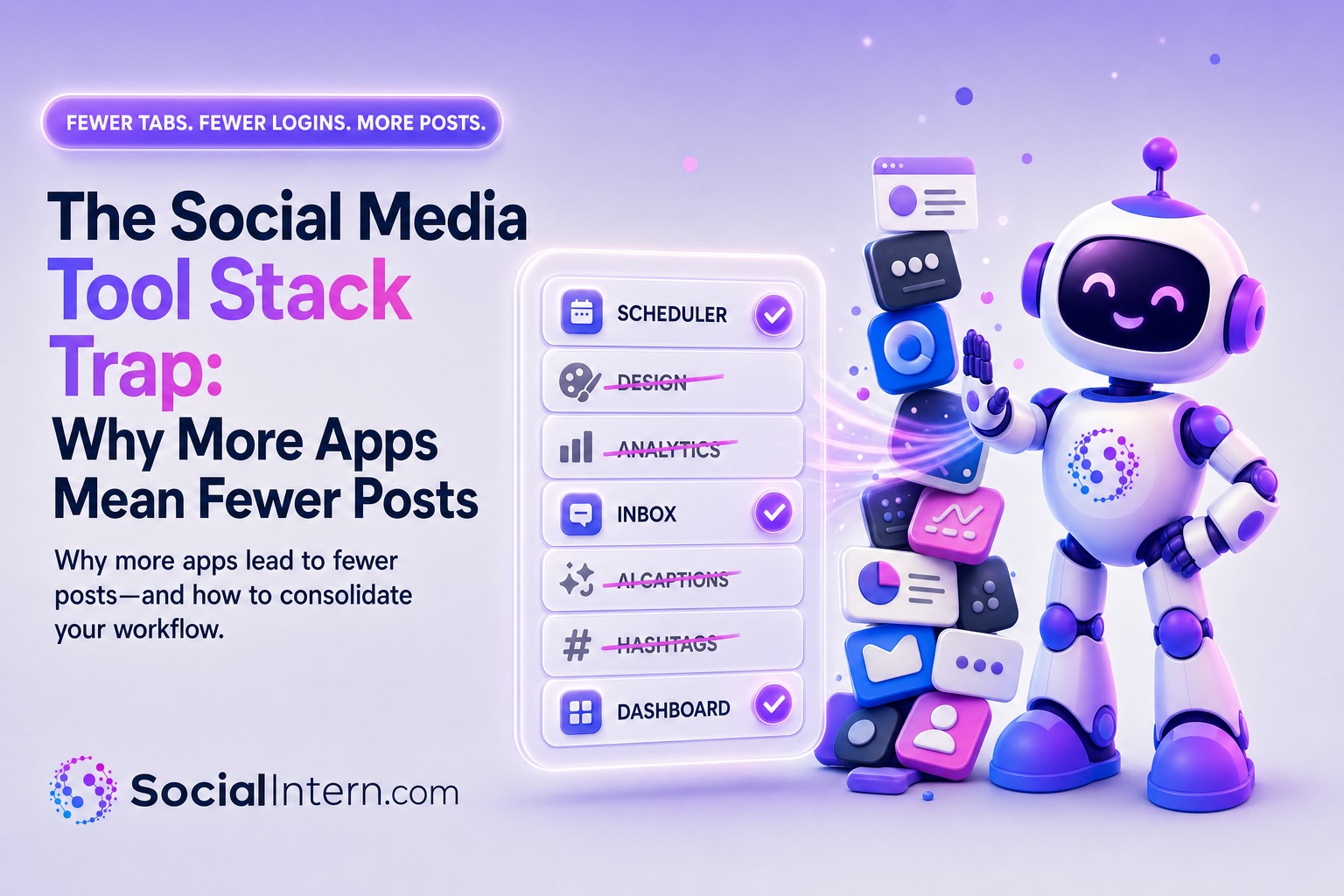
How the social media tool stack grew without anyone deciding to grow it
Nobody sits down on a Tuesday and decides to subscribe to seven social media tools. The stack grows one rational decision at a time. The first one is usually a scheduler, because manually posting at 8am every day got old after week three. Then a design app, because the camera roll photos feel rough next to competitor accounts. Then an analytics dashboard, because the native platform insights stop being enough once there's any volume. Then an AI caption helper, because writing every post from scratch is the slow step. Then a hashtag tool. Then a unified inbox, because DMs are starting to pile up across four platforms.
Each of those additions, in isolation, made sense at the time. The aggregate, six months later, is unreasonable. The owner is paying somewhere between $80 and $300 a month for tools that overlap, contradict, and each require their own ten minutes of orientation when reopened after a few weeks away. Nobody picked this stack on purpose. It assembled itself, the same way a junk drawer does.
The pattern is easy to spot once you see it. SaaS companies are excellent at selling against a single pain point — "you don't have time to write captions, here's a caption tool." They're less interested in whether the caption tool plays well with the four other tools you already pay for. That stitching cost falls entirely on you, and it's almost never priced into the decision to add the next subscription.
The real cost is in the seams
The monthly subscription line is the visible cost. The hidden cost — and it's much larger — sits in the seams between tools. A scheduler and an analytics dashboard from different vendors don't share an ID for "post." So when a Tuesday post does well, figuring out why means cross-referencing two platforms by date and trying to match them up. The design tool exports a 1080×1080 image; the scheduler needs a 1200×630. The AI caption helper writes in a slightly different register than the one you trained on the brand-voice tool. The inbox unifier loses Instagram DMs every two weeks because of a quiet OAuth refresh issue and nobody's caught it.
None of those frictions are large on their own. Five of them, layered, are the reason a planning session that should take forty minutes takes two and a half hours and ends with three posts shipped instead of seven. A founder quoted in the same Reddit thread put it almost too well: "I'm looking for the simplest process that survives real life." Most stacks survive in a clean week. They fall apart the week the business gets busy, which is the week the social media schedule matters most.
The other quiet cost is the reorientation tax. Every tool you don't open weekly takes ten to fifteen minutes to get back into when you do open it. Where was that draft saved. Which folder is the brand kit in. What was the password manager's note again. Multiply by the number of tools opened on a typical Sunday session and the math gets bleak quickly.
What you actually need is shorter than what you're paying for
If you strip the problem down to what a small business genuinely needs to keep social media alive, the list is much shorter than most stacks. There are really four jobs:
- Source: a way to capture topics worth posting about. Usually a notes app and a single album in your phone — not a tool. We wrote about how to mine your own business for topics in the content ideas playbook.
- Draft: something that can turn a topic into a caption and a visual without you starting from a blank page.
- Approve: a place where you say yes or no to what's going out, with the bar low enough that you'll actually do it.
- Publish: one pipeline that delivers the approved post to the platforms you care about, on the cadence you've chosen.
That's the whole job. Almost everything else in a typical stack is either a feature of one of those four steps that's been spun out into its own product, or a category of tool that sounds important but the business doesn't actually act on. A small service business with three employees doesn't run a structured competitive analysis on a weekly basis. It doesn't A/B test caption variants. It barely reads its own analytics. Paying for software that does those things, however well, is paying for capabilities that won't be exercised.
The minimum viable content system, to borrow the Reddit phrase, has one job per step and no more. The minute a tool starts adding capabilities adjacent to its core job, it usually starts charging more and getting harder to use. Owners who run their social media well at small scale are usually using fewer tools than their stack suggests, with most of the work happening in two or three of them.
A weekend audit that cuts most stacks in half
The exercise that works is concrete and takes about forty-five minutes. Pull up your credit card statement and your bookmarks bar at the same time. Write down every active subscription that has anything to do with social media, content, design, or analytics. For most owners this list is between five and twelve items. The number itself is usually the first surprise.
Then go down the list and answer three questions per row. When did I last open this in anger — meaning to actually finish a piece of work, not just to look at it? What does it do that nothing else on the list does? And if I cancelled it tomorrow, what specifically would I be unable to do? The answers cluster quickly. Some tools haven't been opened in two months. Some tools do exactly what another tool does, just with a worse interface. Some tools were bought for a job that has quietly stopped being a job — the analytics dashboard for a quarterly review that hasn't happened in a year.
The rule of thumb from owners who've done this audit is that roughly half the stack falls into the "cancel without consequences" bucket. The other half is doing real work, but often there's a single overlap pair where one of the two can absorb the other's job for free. By the end of the audit a typical service business gets down to two or three social-media-adjacent subscriptions, plus the platforms themselves. The monthly savings are real, but the actual win is the time back — fewer logins, fewer tabs, fewer decisions about which tool to open for which job.
When it's right to add a tool back
Cutting a stack doesn't mean refusing to ever add another tool. It means changing the bar for what gets added. After the audit, the test for adding a tool back is simple: does it replace a step, or does it add one? A tool that absorbs a job you were already doing manually is a candidate. A tool that creates a new step you now have to maintain is almost always net negative, even if the step itself sounds useful.
The shape of a good consolidation, when it shows up, is one tool eating three. A single piece of software that handles drafting and posting and approval is structurally different from three separate tools that each handle one of those steps and have to be wired together. The first has one login, one place where your brand voice lives, and one timeline of what shipped. The three-tool version has six integrations and four places that disagree about what your brand is supposed to sound like.
The same shape applies to the design and visual side. A tool that generates a usable image alongside the caption is doing two of the four jobs in one motion. A tool that produces only an image — with no awareness of the caption it's going to live with — is usually less useful per dollar, because most of the work was matching the two anyway.
The point isn't fewer apps — it's fewer decisions
The real prize on the other side of an audit isn't the smaller credit card statement. It's the smaller cognitive load. Every tool removed from the stack is one fewer decision per session about where to start, which dashboard to trust, and what to do next. The owners who quietly run great small-business social accounts are almost never the ones with the most sophisticated stack. They're the ones whose system is small enough that they don't have to think about the system anymore.
This is the design goal behind Social Intern. The tool covers the four jobs from earlier in one pipeline: it learns your brand voice from your website or one connected social profile during onboarding, generates a week of posts (caption plus image or video) tagged to content pillars built for your business, sends each draft to Slack or email with three buttons — approve, skip, delete — and publishes the approved posts to Instagram, Facebook, X, and LinkedIn on the schedule you set. There is no separate scheduler, no separate design app, no separate AI caption helper. There's one pipeline that runs end to end.
It's worth being honest about what Social Intern doesn't do. It isn't an analytics dashboard. It doesn't manage your DMs or inbox. It doesn't track competitors or run A/B tests on caption variants. For owners who genuinely need those capabilities, a tool that does them well still belongs in the stack — the point of the audit is not to get to one tool, it's to get to as few tools as actually do useful work. For most small businesses, though, the consolidation pattern that holds is the one where the four core jobs sit in one place and the rest of the stack quietly retires. We wrote more about which parts of social media to automate and which to keep manual in the automation post.
If your stack has crept past the point of being helpful, book a demo — and see how much of your current setup it can quietly replace.
A closing thought
Tool sprawl is rarely the headline complaint when a small business owner says social media is too much. The headline is usually time, or ideas, or motivation. Underneath, though, the complaint very often resolves to "I have five accounts open and I don't remember which one I was supposed to do the thing in." That's a stack problem dressed up as a personal problem. Fix the stack first, and the time and the ideas tend to follow. The owner who has one tab open on Monday morning, with a week of drafts waiting to be approved, is not a more disciplined person than the one with seven tabs and nothing shipped. They just got rid of six tabs. A weekend you might have spent inside another tool is probably better spent closing some.
Frequently Asked Questions
For a single-location small business with no dedicated marketing hire, two is usually plenty and three is the upper end. One tool that handles drafting, scheduling, and approval, plus the native analytics inside each platform, covers the vast majority of what the business will actually act on. Anything beyond that needs to justify its existence against a specific weekly job — not a "nice to have."
Cost isn't the reason to cancel — context-switching is. Even free tools incur a logging-in, remembering-where-things-are tax every time they get opened. If two of the three lifetime deals do roughly the same job, pick one, archive your work into it, and stop opening the others. The lifetime deal isn't worth the recurring decision about which one to use on a given Sunday.
The cleanest signal is the "in anger" question — when did you last open this tool to finish a piece of work, not just to check on it. Tools opened weekly to ship something are pulling weight. Tools opened monthly to look at a dashboard, usually aren't. A second-pass test is whether canceling it would force a real behavior change in the business; if the answer is "I'd just stop looking at that number," the number wasn't driving decisions to begin with.
For most small businesses, the history that actually matters lives on the platforms themselves — Instagram still has your old posts, LinkedIn still has your old engagement. The history inside third-party tools is usually a redundant copy of the same data. Before cancelling, export anything you'd want as a record (a CSV of past posts, a folder of brand assets) and check that the platforms hold the underlying facts. Nine times out of ten they do.
It can, and the right defense is portability rather than diversification. The thing you want to be able to walk away with is your brand voice, your content pillars, your customer questions list, and your published-post history. If you can export those, the underlying tool is replaceable. Spreading the same work across five tools doesn't actually reduce lock-in — it just means you have five different exports to do later.
The piece of the stack that makes you actually approve and publish posts. Whatever flow gets a draft in front of you and out to a platform — whether that's a scheduler, an approval inbox, or a tool that combines them — is load-bearing. Cut everything around it before you touch it. The drafting and the design and the analytics are easier to replace than the habit of actually shipping each week.