Most AI social media posts read like AI social media posts. A friendly opener, three bulleted benefits, an obligatory emoji, a CTA that ends in "Let's chat!" If you've scrolled past a hundred of those on LinkedIn this week, you're not the only one. The underlying problem is that the average tool is optimizing for grammatical correctness, not for whether the post is worth reading.
The good news: AI for social media posts has gotten dramatically better in the last eighteen months. The bad news: "better" still doesn't mean "good by default." Getting output that sounds like a real person who knows their stuff takes a few specific design choices — some at the tool level, some at the human-edit level.
This is a practical guide to what AI can actually write well in 2026, what it still can't, and how to spot the tells in a draft before it goes out.
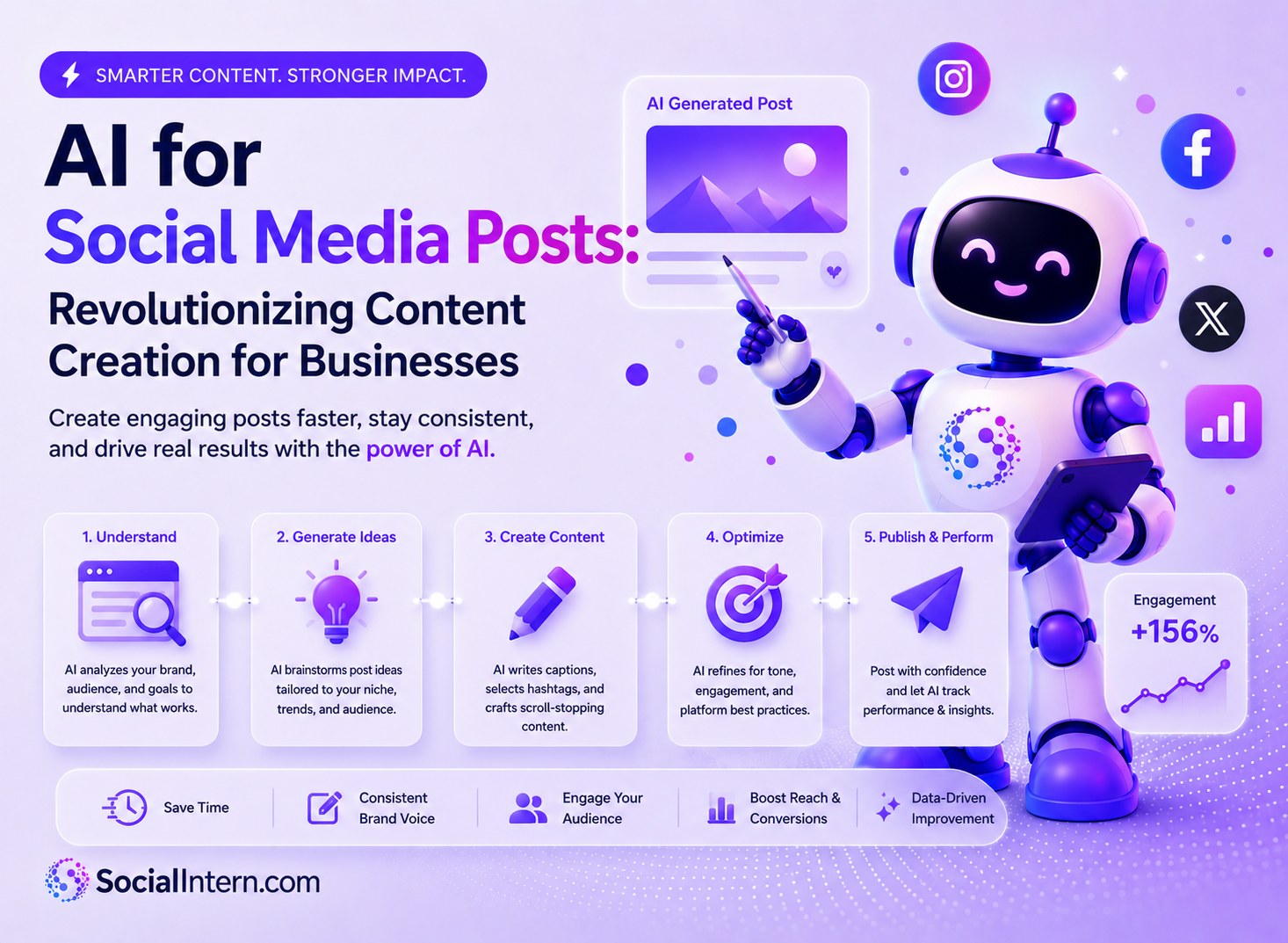
The state of AI for social media posts in 2026
Three things have changed in the last two years that matter for social content. First, long-context models can now read an entire brand's existing content in one pass. That means tone training isn't a separate fine-tuning step — the model can ingest 200 of your past posts and a 40-page brand guide as context, then write the 201st post in the same voice.
Second, image generation has caught up to "usable for non-photo posts." Hero images, illustrations, abstract visuals, and even some lifestyle compositions are now within reach. Photography of real people, places, and products is still better shot.
Third, platform-specific formatting is now table stakes. Any tool worth using produces structurally different drafts for LinkedIn, Instagram, X, and TikTok. If you're using a tool that gives you one string and tells you to paste it everywhere, switch.
The remaining gap is taste. Models can now reliably produce on-brand, well-formatted, grammatically clean posts. What they still can't do reliably is pick the interesting angle on a topic. The human's job has shifted from writing to editing — and editing well is its own skill.
Four things that make AI captions sound like AI
The patterns that flag a post as AI-written, in rough order of how often they appear:
1. The hookless opener. "Excited to share..." "In today's fast-paced world..." "Let's talk about..." These are the AI equivalent of a throat clear. A real opener earns the second sentence — usually with a number, a contrarian take, a question, or a specific scene. Fix: replace the first sentence with something specific to the post. If the post is about a Q3 launch, open with the launch metric, not the launch announcement.
2. The three-benefit pattern. "It saves time. It saves money. It improves quality." Three short parallel sentences that sound like benefits — so over-trained on marketing copy that it's now a tell. Fix: cut to one specific benefit with a number attached. "Cut social media drafting time from six hours a week to ninety minutes" is harder for an AI to invent than "saves time."
3. The "let's" closing. "Let's chat." "Let's connect." "Let's make it happen." Friendly-but-empty closers. They were originally good calls to action; training data now overweights them, so they read as default output. Fix: be specific about the next action. "Reply with the platform you're stuck on" beats "Let's chat."
4. Hashtag carpet-bombing. Twenty hashtags at the bottom of every post, half of them no human would search. AI tends to over-tag because more tags equals higher "reach" in average training-data marketing posts. Fix: use 3–5 hashtags on Instagram, 1–3 on LinkedIn, 0–2 on X. Pick ones with real search volume.
What AI is genuinely good at
A correctly-pointed AI is excellent at a handful of specific jobs:
Variations. "Give me five different opening lines for this post" is the AI's best use case. The model is great at generating range; you pick the best.
Hooks. Specifically, contrarian hooks. "What if I told you..." framings, "the common belief is wrong" framings, hypothetical scenarios — AI generates these faster than you can. You still have to choose the one that's actually true for your brand.
Repurposing. Turning a blog post into six social posts. Turning one LinkedIn post into a Twitter thread. Turning a podcast transcript into ten quote graphics. This is grunt work AI does better than humans because it doesn't get bored.
Hashtag research and platform formatting. "What are the top ten hashtags for B2B SaaS founders on LinkedIn right now?" produces a defensible list. "Format this LinkedIn post with line breaks every two sentences and an opening hook on line one" produces correct formatting on the first try.
What it's still bad at: telling a specific story about your business, picking the angle that will actually resonate this week, and knowing when to break its own pattern.
The minimum viable human-edit pass
Before any AI-drafted post goes live, run it through three checks. The whole pass takes 60–90 seconds per post and catches 80% of the issues.
Check one — opener. Does the first line make me want to read the second? If no, replace it. The AI's first line is usually the most generic part of the draft.
Check two — specificity. Are there at least two specifics in the post — a number, a name, a quote, a date, a tactic? If no, add one. Specifics are the difference between a useful post and AI-generated marketing pablum.
Check three — voice. Read it aloud. Does it sound like someone in your company would actually say it? If it sounds like a marketing intern wrote it, swap two words. Usually that's enough.
Tools that route every AI draft through a fast Slack or email approval flow make this ninety-second pass a habit, not a bottleneck. Faster social content approvals covers the workflow design.
Before and after: a worked example
Before (AI default output):
"Excited to announce that we just launched our newest feature! 🚀 This game-changer will help you save time, scale your business, and unlock new growth. Let's connect and make it happen! #SaaS #Marketing #Growth #Business #Entrepreneur"
After (ninety-second human pass — a fictional accounting firm announcing a service):
"Our monthly bookkeeping tier launches today. $299/month covers payroll, quarterly filings, and a CPA on call.
Three pilot clients moved off their existing software last week — average switching time was about a day.
Reply if you want a walkthrough."
Same shape of announcement. The second version has a specific price, a specific scope, a specific data point, and a specific call to action — and no banned phrases. The human pass took 70 seconds.
For most small businesses, AI drafts plus a ninety-second human pass beats writing from scratch on every dimension. Book a demo and see what the workflow feels like with your own brand voice.
When to skip AI entirely
Cases where AI for social media posts is the wrong tool, even with good editing:
Crisis communication. A complaint going viral, a launch glitch, a competitor's misstep that mentions you — write these yourself. The cost of getting tone wrong in a crisis is higher than the cost of writing the post by hand.
Posts about people. Tributes, hires, departures, founder reflections. AI can sketch them, but the final words should come from a human who knew the person.
Posts that depend on inside-baseball context. If only three people in your industry will get the joke, the AI doesn't have those three people's context. Write it yourself.
For everything else — the 80% of posts that are about content marketing, product education, industry takes, customer wins — AI drafts plus a fast human edit is the right workflow.
Frequently Asked Questions
Look for hookless openers, the three-benefit pattern, "let's" closings, and over-tagging. One of these in a post is forgivable; three together is a tell.
Most won't notice or care, as long as the posts are useful. They'll notice if posts are generic, regardless of whether AI or a tired human wrote them.
Only if they're generic. Specific, useful AI posts perform on par with human-written ones — the issue with poorly-edited AI posts isn't that they're AI, it's that they're vague. Tighten the specifics and the perceived gap closes.
Close, with the right setup. Tools that train on real samples of your existing content — your website, a social profile, or both — get most of the way there. The remaining gap is a quick human edit pass.
You can if you want, but you're not required to. Platform rules don't currently require disclosure; community norms vary by industry.
Batch by week, not by day. Generating a week of posts in one sitting lets you compare drafts side by side and catch repetition before it goes live. Daily generation tends to produce thematically similar posts you didn't notice were similar.