A potential customer Googles "best plumber near me," picks the top three results, and opens each one's website. On yours, they like the photos and the pricing — they're 80% sold. Before calling, they tap your Instagram link.
Your last post is from October.
They scroll for ten seconds, see nothing recent, decide your business might not be active anymore, and call the next plumber on the list. You never know you lost the call. It doesn't show up in any dashboard. There's no "lost lead" event to track. The friction was invisible — and the consequence was real.
This is the part of social media that small service businesses get the most wrong: assuming the job of their Instagram, Facebook, or TikTok is to generate leads, when for most service businesses it's actually to validate leads that came from somewhere else entirely. Reframe the goal and everything downstream — what to post, how often, what success looks like — changes.
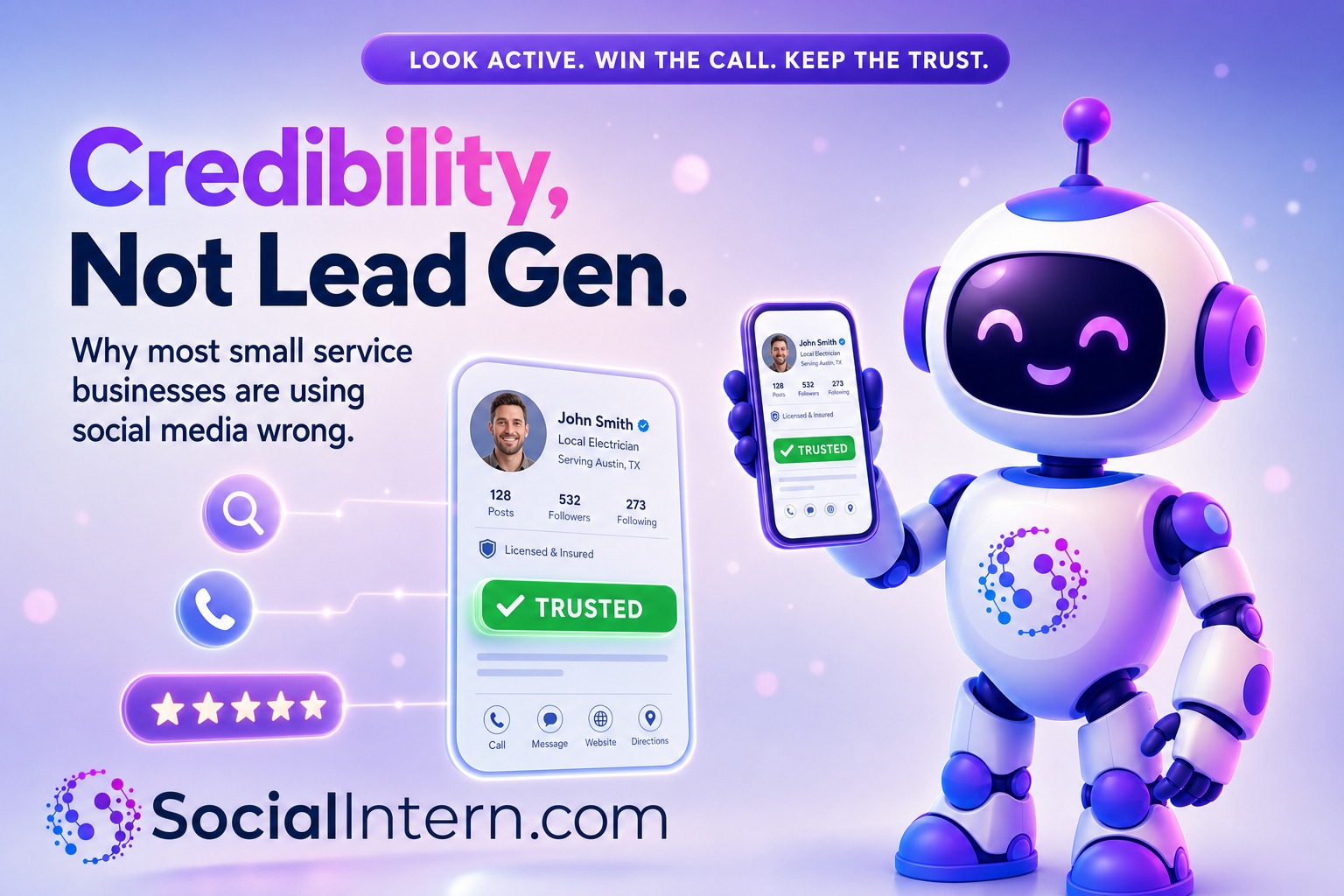
The "lead gen" framing has it backwards
Most social media advice for small businesses is written as though social is the top of the funnel. Followers convert to leads, leads convert to customers, post more, grow your audience, monetize.
That framing works for some categories — e-commerce brands with a discovery-driven buyer, lifestyle businesses with audience flywheels, content creators monetizing reach directly. It does not work for the typical service business. Plumbers, dentists, cleaners, accountants, contractors, lawyers, salons, auto-repair shops — discovery happens almost entirely off-platform. Google search, Yelp, referrals from existing customers, word-of-mouth from a neighbor. Social isn't where the first impression forms; it's where the first impression gets confirmed or contradicted.
The cleanest articulation of this came from a thread of service-business owners on Reddit discussing what social media actually does for them:
"Social media usually ends up more as a credibility check than a lead source."
— Small business owner, r/sweatystartup
Once you internalize that framing, the posts you should be making change completely. The metrics that matter change. The amount of time you spend on social goes way down. The cost of getting it wrong stays high — but in a different way than you've been measuring.
What actually happens between Google and the phone call
The real customer journey for a service business looks roughly like this. The customer realizes they need something — busted pipe, sore tooth, dirty office. They search Google, ask a friend, or remember a business they've heard of. They land on a shortlist of two to four businesses. They check each business's website, reviews, and at least one social profile. Then they call the one that feels safest.
That last check — the social profile scan — is the credibility step. It happens silently. The customer never identifies themselves to you. They just decide whether your business "looks alive and competent" enough to risk a phone call.
The signal they're looking for isn't follower count. It's not engagement rate. It's not viral reach. As one owner on r/smallbusiness put it:
"When the page feels inactive, calls slow down."
If your most recent post is from last year, your cover photo is a placeholder, or your bio still has the default template text from when you set the account up, the credibility check fails. The customer moves on to the next business on the list. The lost call doesn't show up in analytics because it never became an interaction with your business.
The bar is "not dead," not "viral"
Once you reframe social as credibility validation, the bar for success drops dramatically.
You do not need a content strategy with five pillars. You do not need daily posts. You do not need a viral video, a five-thousand-follower audience, or a consistent visual brand across every post. What you need is a recent post (ideally within the last one or two weeks), a bio that clearly identifies what your business does, a profile photo that looks intentional, a small handful of posts that prove you do real work, and a clear way to contact you from the profile.
That's the whole bar. A restaurant doesn't need to be packed every night to look open — it just needs the lights on. Your social profile is the lights.
What credibility-shaped content looks like
If virality isn't the goal, the math on what to post changes. The job of every post is simpler: demonstrate that you do the work you say you do, recently. Anything else you want to layer on — educational content, entertainment, trending posts, holiday tie-ins — rides on top of that foundation rather than replacing it.
High-credibility, low-effort post types for service businesses:
- Work-in-progress shots. A photo of you mid-job. Doesn't have to be polished — the point is "yes, this business is doing the thing."
- Before-and-afters. The dental cleaning, the deep-cleaned office, the fixed pipe. Two photos side by side. Always works.
- Customer wins. A short caption thanking a customer (with permission) or pointing to a recent Google review.
- Team photos. Even the smallest business has a face behind it. Showing it builds trust faster than any clever caption.
- Availability updates. "Booking July appointments now." Practical, useful, and proves the business is operating.
How to know it's working without an analytics dashboard
The frustrating part of credibility-as-goal is that the wins are invisible. You can't see the customer who would have called the next plumber on the list but didn't because your Instagram looked alive. There's no event to log.
Three indirect signals to watch instead:
Time from inquiry to booking. A customer who already validated you on social arrives ready to book. If your conversion rate from inquiry to confirmed customer goes up after a stretch of consistent posting, that's the credibility check paying off.
Customer mentions. Ask new customers, "How did you find us?" and then follow up with, "Did you check our social before calling?" If the answer is yes — even some of the time — your social is doing work you couldn't otherwise measure.
Competitive wins. If you're picking up customers who tell you they considered a competitor and chose you, ask why. "Your page looked active" or "your reviews were better and your Instagram had recent posts" are signals the validation channel is doing its job.
You will not see any of this in a dashboard. The point is to stop expecting to.
Making the bar realistic to actually hit
The reason most small business owners abandon social media isn't laziness — it's that "post consistently and grow an audience" is a bigger commitment than the return justifies for credibility purposes. The good news: when the job is credibility, the cadence required is much lighter.
A realistic minimum for most service businesses is one post per week, every week, where each post is a thirty-second phone photo with one sentence of caption. A planned batch on the first weekend of each month keeps the queue full.
Even that minimum is more than most service businesses sustain on their own. The "post once a week" plan looks easy until the third week, when real work eats the planned posting time. The pattern is so consistent it has a name:
"Marketing plan falls apart by week 3. Real work hits, and posting is what gets dropped."
This is the gap automated tools fill. Social Intern handles the cadence problem directly — it generates and schedules a week of posts at a time, drafted in your brand voice, and you approve them in Slack or email when you have ninety seconds. For credibility-shaped content, you don't need to write or polish the posts yourself. You just need them to keep happening.
For most service businesses, the right starting point is a recent, professional, recognizable social profile — nothing more, nothing less. Book a demo and have your next week of posts queued up without writing them yourself.
When this advice does not apply
For completeness, the "credibility, not lead gen" framing is for service businesses with off-platform discovery channels. It does not apply to e-commerce brands whose customers actually discover them on social, influencer or creator businesses whose business model is reach, brands with content as a primary product (publishers, agencies, education businesses), or businesses doing paid social advertising — in that case, social is lead gen, but through a different mechanic.
If your customers are finding you through Instagram in the first place, "post for credibility" is the wrong advice. For everyone else — the contractors, cleaners, dentists, plumbers, accountants, salons, repair shops, and the rest of the service economy — credibility is the goal. Aim there and the rest gets simpler.
Frequently Asked Questions
Weekly is solid. Every other week is the minimum. Less than that and the profile starts to feel inactive — which is the one outcome you're trying to avoid.
That's the most common scenario. Automated tools that draft and schedule posts for you (with a quick approval step) close this gap. Social Intern's weekly batch generation is built specifically for this case — the goal is not to add another task to your week.
For most local service businesses, lead generation through organic social is a lower-ROI activity than improving your Google profile or asking past customers for referrals. For e-commerce and content businesses, the math is different — social can be a real discovery channel there.
Recency of your last post. Professional appearance of the profile. Customer mentions of having checked your social before calling. Inquiry-to-booking conversion rate over time. None of these will live in a single dashboard, which is exactly why most owners stop measuring social entirely.
Open your own profile from an incognito window like a potential customer would. If the most recent post is over a month old, the bio is unclear, or the photos look low-effort, the profile is probably costing you calls you'll never see.
Yes. Personal brands and content creators have reach-based business models — for them, social is the product, not a credibility check. The framing in this post is for service businesses where the customer relationship lives off-platform and social is supporting the existing funnel, not driving it.