For technical marketing leads, dev teams, and privacy officers, brand voice consistency isn't a "nice-to-have." It's a system requirement. Every caption, carousel, or campaign asset must reflect tone, positioning, compliance boundaries, and funnel intent.
At Social Intern, our AI engine is designed to transform structured brand data into on-brand, conversion-driven social content. This isn't generic text generation. It's controlled AI brand modeling.
And when integrated with our full social media management software, teams gain not only voice alignment, but execution governance, analytics mapping, and audit trails.
Let's break down how it works.
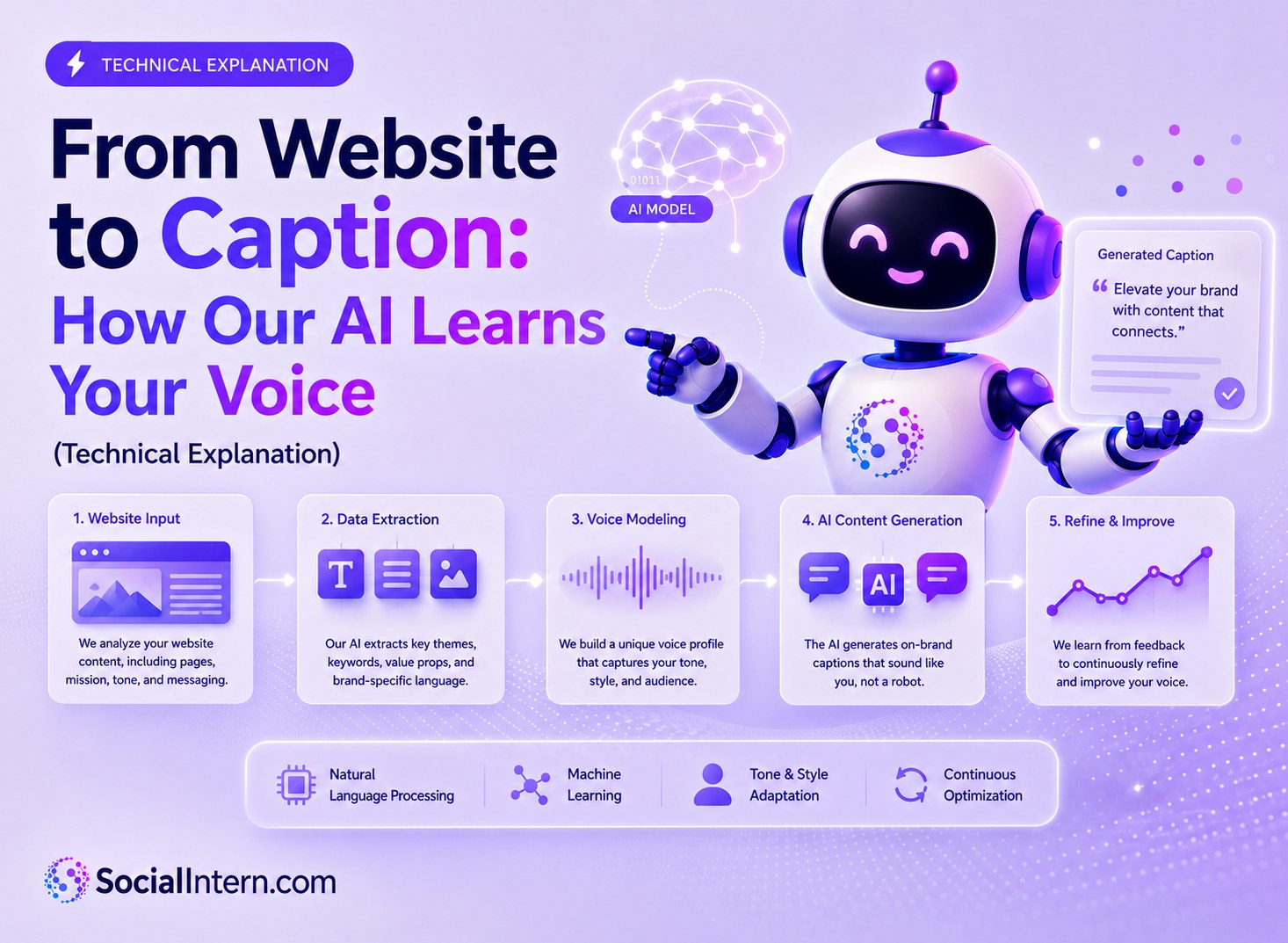
Overview: The Brand Voice Learning Pipeline
Our AI voice system operates in six structured layers:
- Data ingestion
- AI brand analysis
- NLP tone extraction
- Brand embedding generation
- Fine-tuning and constraint modeling
- Output validation and explainability
Each stage is engineered for repeatability, privacy compliance, and voice precision.
1. Data Sources: What We Analyze
When clients onboard, we define structured and approved data sources.
Typical inputs include:
- Website copy (core pages, blogs, landing pages)
- Brand guidelines
- Past social media posts
- Product descriptions
- Founder messaging
- Public-facing documentation
We do not scrape data without consent. All ingestion follows explicit approval and documented scope.
Website Scraping for Tone (Controlled & Scoped)
When approved, we conduct structured website scraping for tone using controlled crawling parameters:
- Limited domain scope
- Exclusion of gated/private areas
- Respect for robots.txt where applicable
- Tokenized ingestion (no raw storage unless required)
We do not store full website mirrors. Instead, we extract tonal and structural features:
- Sentence length distribution
- Reading grade level
- Sentiment polarity
- Vocabulary density
- CTA framing patterns
- Value proposition phrasing
This becomes the foundation for brand modeling.
2. AI Brand Analysis: Structural & Linguistic Modeling
Our AI brand analysis layer parses content across:
A. Lexical Signals
- Repeated keywords
- Industry-specific jargon
- Branded phrases
- Power words
B. Syntactic Patterns
- Sentence complexity
- Active vs passive voice
- Declarative vs persuasive structure
C. Semantic Themes
- Core positioning
- Audience pain points
- Solution framing
- Emotional tone
D. Conversion Language
- CTA frequency
- Urgency markers
- Authority indicators
- Social proof signals
This multi-dimensional modeling allows us to build a quantifiable voice profile - not just a subjective one.
3. NLP for Brand Voice: How Tone Is Encoded
We use advanced NLP for brand voice encoding through embedding models.
Process:
- Text segmentation
- Vector embedding generation
- Tone clustering
- Sentiment calibration
- Style fingerprint mapping
Each brand develops a "voice embedding signature."
This signature guides caption generation by:
- Constraining word selection probabilities
- Adjusting formality levels
- Preserving brand-specific idioms
- Aligning CTA cadence
In simple terms: the AI doesn't "guess" your voice. It generates within learned tonal boundaries.
4. Fine-Tuning & Controlled Adaptation
Beyond embeddings, we apply structured fine-tuning techniques:
- Supervised learning on approved brand examples
- Constraint injection layers
- Reinforcement scoring on brand-aligned outputs
- Prompt architecture optimization
We do not permanently retrain base foundation models on private client data.
Instead, we use:
- Isolated adaptation layers
- Brand-specific prompt conditioning
- Contextual injection at inference time
This ensures client data remains siloed.
5. Output Validation & Model Explainability
Technical stakeholders often ask: "How do we know the AI isn't hallucinating a tone?"
We implement explainability checkpoints:
- Tone deviation scoring
- Keyword drift detection
- Compliance filters
- CTA alignment checks
- Confidence scoring
This enhances model explainability and governance.
6. Privacy & Data Safeguards
Privacy is not an afterthought - it is engineered into the system.
Our safeguards include:
- Explicit ingestion consent
- Scoped crawling
- Encrypted data transfer
- Role-based access control
- Data minimization principles
- No cross-client model contamination
We never use private client data to train unrelated accounts.
For privacy officers, documentation of data sources, retention windows, and deletion policies is available upon request.
Explore the industries we serve and find the right AI-driven social solution for your business.
Why Outputs Match Brand Voice
Here's the critical technical insight:
Generic AI tools rely heavily on prompt engineering. We combine:
- Structured ingestion
- Voice embeddings
- Constraint conditioning
- Fine-tuned inference
- Validation scoring
The result is:
- Consistent tone
- On-brand vocabulary
- Accurate CTA cadence
- Positioning alignment
- Funnel-stage awareness
This is why Social Intern captions sound like your brand - not a template.
Real-World Workflow: From Website to Caption
Let's walk through an example:
- Step 1: Website ingestion
- Step 2: Tone vector generation
- Step 3: Brand positioning mapping
- Step 4: Campaign brief input
- Step 5: Funnel stage identification
- Step 6: Caption generation within tonal constraints
- Step 7: Publishing via management dashboard
All within a controlled AI environment.
Measuring Voice Consistency
Quantitative metrics include:
- Tone similarity scoring
- Brand keyword density
- CTA structural alignment
- Engagement lift vs baseline
- Funnel-stage response rates
Voice isn't just aesthetic - it's measurable.
E-E-A-T Alignment
Search engines and audiences reward:
- Demonstrated expertise
- Authoritative tone
- Trust consistency
- Real experience signals
Our system preserves these markers in every generated caption.
Common Technical Questions
Does the AI copy website text directly?
No. It extracts tonal and structural signals, not wholesale content.
Is client data used to train other brands?
No. Adaptation layers are account-isolated.
What about compliance-heavy industries?
We integrate rule-based guardrails for finance, healthcare, and regulated sectors.
Have questions about our approach? Explore our frequently asked questions to learn how it works and how to get started.
Conclusion: Structured Intelligence, Not Guesswork
When people ask, how does Social Intern learn brand voice - the answer is simple in principle but complex in execution. We combine structured AI brand analysis, advanced NLP tone modeling, scoped website scraping for tone, controlled fine-tuning layers, governance safeguards, and rigorous output validation mechanisms.
Each component works together within a secure, consent-driven framework to ensure that generated content aligns precisely with your brand's positioning and linguistic patterns. The result is consistent, explainable, and privacy-conscious brand voice generation - engineered to meet the technical standards and compliance expectations of modern marketing and development teams.
Contact us to schedule a technical walkthrough of our AI voice modeling system and see how it integrates with your workflow.
Frequently Asked Questions
We ingest approved content sources, generate voice embeddings, apply NLP tone modeling, and use controlled fine-tuning with validation layers.
No. We extract tonal features and structural signals under scoped, consent-based crawling.
No. We use isolated adaptation layers without cross-client contamination.
Through consent-based ingestion, encrypted storage, role-based access control, and strict data minimization policies.